60-Day Discipline Challenge Journal: Build Better Habits
Building lasting discipline isn't about motivation—it's about structure. The 60-Day Discipline Challenge Journal offers exactly that: a clear, repeatable system designed to turn intention into action. Whether you're working on fitness, productivity, or personal growth, this journal provides the daily framework needed to stay consistent and accountable over two full months.
What makes this tool stand out is its balance between simplicity and depth. It doesn't overwhelm you with complexity, but it gives enough structure to make real progress feel inevitable. Let's explore what this journal offers, how different users can adapt it, and why it works for such a wide range of goals.
What the 60-Day Discipline Challenge Journal Actually Does
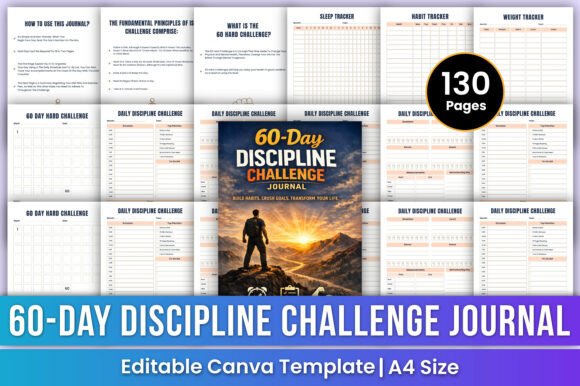
At its core, this journal is a guided system for building habits and tracking progress over 60 days. Each day includes space for planning, prioritising, and reflecting. You get daily planning pages with sections for schedules, to-do lists, and key priorities. Alongside those, there are dedicated habit tracking grids where you can log workouts, water intake, reading, or any routine you want to cement.
The health and fitness tracking pages let you monitor diet, exercise, and body measurements across the full challenge. Meanwhile, progress reflection sections give you room to check in with yourself daily—what worked, what didn't, and what you'll adjust tomorrow. Additional trackers for weight, sleep, and habits round out the system, so nothing falls through the cracks.
Because it comes with an editable Canva link, you can customise the layout, colours, or prompts to match your personal style or coaching brand. That flexibility makes it useful for individuals, but also for coaches, bloggers, or creators who want to offer a structured challenge to their audience.
Who Benefits Most from This Journal
The 60-day format hits a sweet spot. It's long enough to form real habits, but short enough to feel achievable. Here's how different people can use it effectively.
Goal setters and productivity lovers
If you thrive on clear targets and measurable outcomes, this journal gives you a daily rhythm to keep moving forward. Use the planning pages to break big projects into small, daily actions. The habit tracking becomes a visual record of your consistency. Over 60 days, you'll see exactly where your effort went—and where you might need to adjust.
Fitness and habit builders
For anyone working on physical health, the tracking pages are invaluable. Log workouts, water intake, and meals. Use the body measurement tracker to see changes over time. The daily reflection space helps you notice patterns—like which workouts you skip or what meals leave you feeling energised. That awareness alone can shift your results.
Students and professionals
Discipline isn't just about exercise. Students can use the journal to track study hours, assignment deadlines, and reading goals. Professionals can treat it as a 60-day productivity accelerator, focusing on one key project or skill. The structure works for any domain where consistency matters.
Personal development enthusiasts
If you're exploring mindfulness, journaling, or emotional habits, the reflection sections become your anchor. You can track moods, gratitude entries, or meditation sessions. Over 60 days, you'll build a clear picture of your inner habits and how they affect your daily life.
Creative Ways to Adapt the Journal for Different Goals
One of the strengths of this journal is how adaptable it is. Here are some practical ideas for getting more out of it, depending on your context.
Use the daily pages as a decision log
Instead of just listing tasks, treat each daily page as a record of key decisions. Write down one important choice you made that day and why. Over 60 days, you'll have a decision journal that reveals your priorities and patterns. This is especially useful for entrepreneurs or freelancers who want to sharpen their judgement.
Layer in a weekly review ritual
Use the reflection pages not just daily, but as a weekly checkpoint. Every seven days, look back at your habit streaks, completed tasks, and notes. Ask yourself: What am I avoiding? What's working easily? Where am I resisting? This turns the journal into a self-coaching tool, not just a log.
Combine with a coaching or group challenge
If you're a coach, trainer, or content creator, the journal can become the backbone of a paid or free challenge. Share the editable Canva link with your audience. Run a 60-day group challenge where participants check in daily using the journal's structure. You can create weekly discussion topics based on the reflection prompts. This builds community and accountability around your expertise.
Customise for a specific habit stack
Instead of tracking generic habits, customise the Canva template to focus on one specific stack. For example: morning routine + deep work session + evening wind-down. Or a combination of hydration + steps + reading 10 pages. The more specific the habit stack, the easier it is to stay consistent because you're not deciding what to do each day—you're just executing.
How to Keep Results Clear and Organised
A journal is only useful if you can actually see your progress. Here's how to make the most of the tracking sections.
Be ruthlessly specific with your habits
Don't write "exercise" as a habit. Write "30-minute walk before breakfast" or "gym session at 6 PM." The more specific the habit, the easier it is to track honestly. Vague habits are easy to skip because you can rationalise them. Specific habits leave no room for fudging.
Use the measurement tracker consistently
If you're tracking body measurements, weight, or fitness metrics, pick one day and time each week to log them. Same scale, same time of day, same conditions. Consistency in measurement matters more than the numbers themselves. Over 60 days, trends will emerge that motivate you far more than any single data point.
Make reflection a non-negotiable
The daily reflection space might seem optional, but it's where the real learning happens. Spend two minutes each evening asking: What went well today? What could I improve? What will I do tomorrow? This simple loop turns experience into insight. Without it, you're just collecting data—not building wisdom.
Why the 60-Day Format Works for Discipline
Research on habit formation suggests that while simple habits can form in 21 days, more complex behaviours take longer to automate. Sixty days gives you enough time to push through the early awkward phase, the middle slump, and into genuine consistency.
You'll likely experience a pattern: enthusiasm in week one, resistance in weeks two and three, and a steadier rhythm from week four onward. The journal helps you see that pattern clearly. When you know resistance is normal, you're less likely to quit. You can remind yourself that week two slump is exactly when the habit starts to stick.
That's the real value of a structured challenge. It doesn't eliminate the hard parts—it gives you a map so you don't get lost.
Practical Recommendations for Getting Started
If you're picking up the 60-Day Discipline Challenge Journal KDP version, here are a few suggestions to set yourself up for success.
- Print the full journal at once. Having all 60 days in a physical binder or notebook makes it harder to skip a day. Digital files are convenient, but paper creates a different level of commitment.
- Customise the Canva template before printing. Adjust the habit categories, reflection prompts, or colour scheme to match your personality. A journal that feels like yours is easier to use daily.
- Start on a Monday. It's a small thing, but beginning the challenge at the start of a week gives you a natural rhythm. You'll also align with most goal-setting cycles.
- Share your progress publicly if you can. Posting weekly updates on social media or in a group adds accountability. Even one friend checking in with you can double your chances of completing the 60 days.
- Forgive missed days but never skip two in a row. Perfection isn't the goal. If you miss a day, log it honestly, reflect briefly, and continue the next day. Two missed days in a row often lead to abandoning the challenge entirely.
Who Else Can Use This Journal
Beyond individual use, this journal works well in several professional contexts.
Bloggers and content creators can document their own 60-day challenge and turn it into a content series. Each week becomes a blog post or video update. The journal provides the structure; your experience becomes the content.
Small business owners can use it to track business habits like networking outreach, content creation, or daily learning. The same discipline principles apply whether you're building a fitness habit or a marketing routine.
Educators and workshop facilitators can adapt the template for student goal-setting programs or personal development courses. The structured format gives participants a clear path to follow, which increases completion rates.
Freelancers and designers can use the daily planning pages to manage multiple projects. The habit tracking becomes a way to ensure you're investing time in skill development, client work, and rest—not just the urgent tasks.
Discipline as a Skill, Not a Trait
The most important shift you can make is to stop thinking of discipline as something you either have or don't. It's a skill you build through consistent practice. The 60-Day Discipline Challenge Journal is a training tool for that skill. Each day you use it, you're exercising your ability to follow through, to prioritise, and to show up even when you don't feel like it.
After 60 days, you won't just have a completed journal. You'll have a deeper understanding of how you work, what motivates you, and where your real edges are. That knowledge is worth more than any single habit you track.
Whether you're using the editable Canva link to create a custom version or printing the ready-made PDF files, the key is to start. Pick one habit, one focus, and one daily check-in. Let the journal do the rest.