Creative Thinking Activities for Practical Growth
Creative thinking is often described as a soft skill, yet its impact on daily work, learning, and problem-solving is anything but soft. For professionals, educators, entrepreneurs, and lifelong learners, the ability to generate fresh ideas, connect unrelated concepts, and approach challenges from new angles can make the difference between stagnation and meaningful progress. The Creative Thinking Activities Workbook offers a structured yet flexible way to build these capabilities, whether you are guiding a classroom, homeschooling a child, or looking to strengthen your own creative muscles.
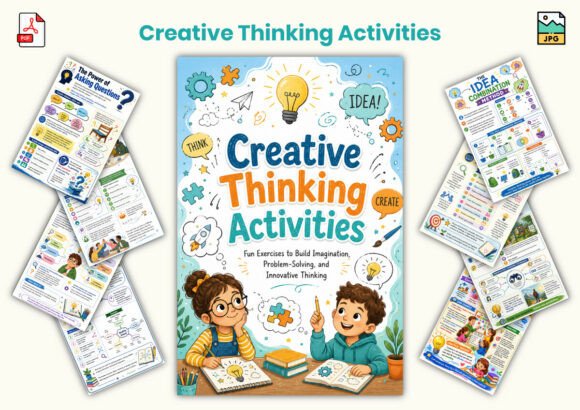
This workbook is not a collection of random puzzles. It is a thoughtfully sequenced set of 31 unique pages that move from observation and brainstorming to reflection and action planning. Each page presents a different challenge, encouraging the user to think in ways that may not come naturally. For adults helping young learners, this means you can trust that the activities are building real cognitive skills, not just keeping someone busy.
Why Creative Thinking Deserves a Structured Approach
Many people assume creativity is something you either have or you do not. In reality, creative thinking is a skill that responds well to practice, especially when that practice is varied and intentional. The workbook’s design reflects this principle. It includes exercises in brainstorming, mind mapping, observation, storytelling, invention, and self-assessment. By moving through different types of tasks, learners develop flexibility rather than simply repeating one kind of thinking.
For educators and parents, this variety is particularly valuable. A child who struggles with open-ended storytelling might excel at observation challenges or invention exercises. The workbook allows strengths to emerge while gently pushing against weaker areas. It also gives adults a clear window into how a learner thinks, which can inform future teaching or mentoring strategies.
Professionals and entrepreneurs can also benefit directly. While the workbook is marketed toward children and students, many of the exercises translate well to adult creative practice. Brainstorming activities, mind mapping templates, and action plans are tools that help generate ideas and move them toward implementation. The reflection pages, in particular, are useful for anyone who wants to review their own creative process and identify where they get stuck.
Building Observation and Curiosity
One of the first skills the workbook addresses is observation. In a world full of distractions, the ability to notice details, patterns, and anomalies is rare. The observation challenges are designed to train the eye and the mind to pay closer attention to everyday environments. For a classroom teacher, these activities can be a warm-up that shifts students into a more attentive state. For a freelancer or creative professional, they can serve as a reset when inspiration feels flat.
Curiosity is closely linked to observation. The workbook encourages learners to ask questions, explore possibilities, and resist the urge to settle for obvious answers. This is not about coming up with wild ideas for the sake of it. It is about developing a habit of looking at problems from multiple angles before deciding on a solution. Over time, this habit makes problem-solving faster and more effective because the first idea is rarely the best one.
Problem-Solving as a Creative Act
Problem-solving is central to the workbook. However, the tasks are not the kind that have a single correct answer. Instead, they challenge learners to generate multiple solutions, weigh trade-offs, and think about consequences. This mirrors real-world decision-making far better than worksheets that ask for one right answer.
An entrepreneur working on a business challenge might use the problem-solving pages to map out possible responses to a market shift. A parent helping a child with a school project could use the same pages to break a complex assignment into manageable parts. The Creative Thinking Activities Workbook provides a framework that works across contexts because the thinking patterns it teaches are universal.
The innovation and invention exercises take problem-solving a step further. They ask learners to combine existing ideas in new ways or to invent something that solves a specific need. This is the kind of thinking that drives product development, content creation, and process improvement. Even if the user never builds a prototype, the mental workout strengthens their ability to see connections where others see only separate pieces.
Storytelling and Imagination Activities
Storytelling is more than entertainment. It is how humans make sense of information, persuade others, and remember lessons. The workbook includes imagination and storytelling activities that encourage learners to create narratives around ideas. For a marketer, this can translate into better brand stories and more engaging content. For an educator, it offers a way to help students internalize concepts that might otherwise feel abstract.
These exercises also build empathy. When a child or adult has to imagine a scenario from another perspective, they practice seeing the world through someone else’s eyes. That skill is invaluable in leadership, customer service, and collaboration. The workbook’s reflection pages reinforce this by asking learners to evaluate their own responses and consider how they might approach a task differently next time.
Reflection and Action Planning for Lasting Change
Many creative programs stop at generating ideas. This workbook goes further by including reflection pages and creativity action plans. Reflection helps users understand what worked, what did not, and why. Action planning turns insights into next steps. For a student, that might mean choosing to brainstorm more before starting a project. For a professional, it could mean scheduling regular creative time or using a new technique for team meetings.
The self-assessment pages are especially useful for older students and adults. They provide a structured way to evaluate creative confidence, identify strengths, and set goals. A teacher might use these pages to track a student’s growth over a semester. A freelancer could use them to check in on their own creative habits every few months.
The workbook’s size—6 by 9 inches—is practical for slipping into a bag or keeping on a desk. It does not feel like a textbook. The layout is clean and easy to read, with enough white space that each activity feels approachable rather than overwhelming. The print-ready design means you can use it at home, in a classroom, or in a workshop setting without worrying about formatting issues. Both PDF and JPG formats are included, which adds flexibility if you want to project a page on a screen or print individual sheets for a group.
Who Benefits Most and Why
While the workbook is pitched at children and students, its real audience is broader. Parents who homeschool or supplement school learning will find a ready-made resource that does not require extensive prep. Classroom teachers can integrate individual pages into lesson plans or use the workbook as a station activity. Tutors and mentors working one-on-one with students will appreciate the variety, which keeps sessions fresh.
Professionals and entrepreneurs should not dismiss this workbook because of its youthful framing. The thinking exercises are the same ones used in corporate innovation workshops and creative agency brainstorming sessions. The difference is that this workbook delivers them in a portable, affordable format. A marketing professional looking to generate fresh campaign ideas, a blogger working through writer’s block, or a small business owner trying to solve a logistics challenge can all benefit from the same structured approach.
Freelancers and creators who work alone often lack external input. The workbook can serve as a stand-in for a brainstorming partner. The prompts push you to think in directions you might not choose on your own. The action plans keep you accountable. Over time, using the workbook regularly can build a habit of creative thinking that carries into your main work.
Limitations and Fit Considerations
No single resource works for everyone, and this workbook is no exception. The activities are designed for independent or guided use, but some learners may need more hands-on facilitation, especially younger children or those who struggle with written tasks. Adults who are looking for deep theoretical content on creativity will not find it here. This is a practice workbook, not a textbook. It is meant to be used, not studied.
If you are a professional seeking highly advanced creative techniques, you may find some activities too basic. That said, even experienced creative thinkers often benefit from returning to fundamentals. The best strategy is to scan the content and decide which pages match your current needs. You can use the workbook selectively rather than working through it cover to cover.
For educators, the workbook works best when integrated into a broader curriculum. It is a supplement, not a replacement. Teachers should preview each activity to see how it aligns with their learning objectives. Parents using it at home can pair it with discussion or real-world exploration to deepen the impact.
Practical Recommendations for Use
To get the most out of the Creative Thinking Activities Workbook, treat it as a tool you return to rather than a one-time task. Set aside 15 to 20 minutes a few times per week to work through a page. Discuss the results with someone else if possible. Verbalizing your thinking process strengthens learning and often leads to new insights.
Educators can assign pages as warm-ups, homework alternatives, or enrichment for students who finish other work early. The variety means you can match an activity to a student’s mood or needs on a given day. If a student seems stuck on a writing assignment, an imagination or storytelling exercise might unlock their creativity. If a group is struggling to cooperate, a brainstorming or mind mapping activity can get them communicating.
Professionals can use the workbook as a personal creativity warm-up before tackling demanding work. Pick a page at random, set a timer, and allow yourself to play with the prompt. The goal is not to produce polished work but to shift your mind into a more flexible state. Over weeks and months, this practice can lead to noticeable improvements in how you generate ideas and solve problems.
For parents, the workbook offers a chance to model creative thinking. Work through a page alongside your child. Share your thought process. Show them that you also get stuck sometimes and that the value is in trying, not in being perfect. This kind of shared activity builds both skills and relationships.
The clean, professional layout and artistic theme make the workbook pleasant to use. It does not feel like a chore. That matters because creative thinking flourishes in environments where people feel safe and engaged. Whether you are a teacher, a parent, an entrepreneur, or a lifelong learner, this workbook gives you a practical, no-fuss way to develop a skill that touches almost every part of life and work.