Kids Puzzle Adventure: Evaluating the Activity Planner for Ages 4–8
When choosing screen-free activities for young children, parents and educators often look for resources that balance entertainment with developmental benefits. Kids Puzzle Adventure is one such resource—a printable activity planner designed for children aged 4 to 8 years. It includes 30 pages of puzzles, mazes, hidden object games, and other interactive tasks that aim to build cognitive skills. This article provides a balanced evaluation to help you decide whether this book aligns with your child’s needs, interests, and learning goals.
What Is Kids Puzzle Adventure?
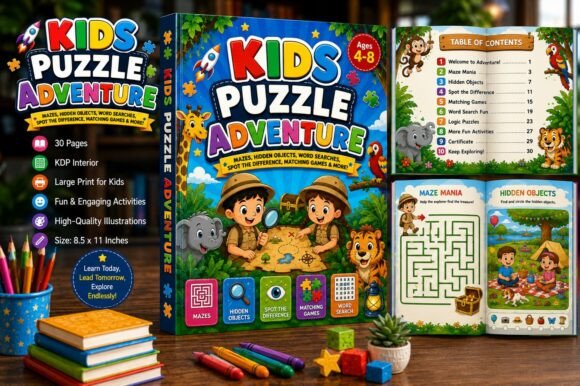
Kids Puzzle Adventure is a collection of themed puzzle pages that can be printed or used digitally. The activities span multiple formats: mazes with jungle, ocean, and space settings; hidden object scenes; spot-the-difference challenges; connect-the-dot sequences; matching games (including shadow matching and picture pairs); and logic puzzles such as pattern recognition and odd-one-out tasks. Each page is formatted at 8.5×11 inches and is ready to upload or print. The book’s structure is non-linear—children can choose pages based on interest rather than following a set curriculum.
The target age range—4–8 years—covers both preschool and early elementary stages. This means the difficulty spans from simple line-following mazes to more complex logic puzzles, which is important for matching the book to a specific child’s current ability level.
Why Parents and Educators Consider It
Several factors typically drive interest in activity planners like Kids Puzzle Adventure. First, the format is entirely screen-free, which appeals to caregivers looking to reduce digital dependency. Second, the variety of puzzle types means a child can practice multiple cognitive skills without needing separate books. Third, the themes—jungle, ocean, space—add an element of narrative adventure that can sustain engagement over repeated use.
However, it is worth noting that the book is not a structured curriculum. It does not teach new concepts step-by-step but rather reinforces skills through practice. For a child who already enjoys puzzles, this can be motivating; for a child who finds them frustrating, additional guidance may be needed.
Skills Developed and Learning Outcomes
Each puzzle type in Kids Puzzle Adventure targets specific developmental areas. The following list outlines the primary skills each activity addresses:
- Mazes – spatial reasoning, planning, fine motor control (if traced with a pencil or finger).
- Hidden object games – sustained attention, visual scanning, working memory.
- Spot the difference – visual discrimination, attention to detail, patience.
- Connect the dots – number sequencing, hand-eye coordination, number recognition (for numbers typically up to 30–50).
- Matching activities – categorization, visual memory, logical association.
- Logic and pattern puzzles – critical thinking, deductive reasoning, flexibility in problem-solving.
These skills are foundational for reading, math, and everyday problem-solving. Because children work at their own pace, the book can also promote a sense of accomplishment and independent work habits.
Strengths
- Variety in one volume: Thirty different pages means no two play sessions need to feel identical. The mix of low-difficulty (e.g., simple hidden objects) and moderate-difficulty activities (e.g., complex mazes or multi-step logic) allows for progression.
- Age-appropriate design: The illustrations and themes are appealing without being overly childish, and the instructions are generally simple enough for a 4-year-old to understand with minimal adult help.
- Printable and reusable: Because the PDF can be printed multiple times, siblings or classroom groups can use the same pages. Laminating makes them reusable with dry-erase markers.
Potential Limitations
- No answer key: For puzzles like spot-the-difference or odd-one-out, some children may need confirmation of correct answers. Without a solution guide, a parent or teacher may need to verify results.
- Limited adaptivity: The book does not adjust difficulty based on performance. A child who finishes all mazes quickly may need supplementary challenges, while a child who struggles may lose motivation without scaffolding.
- Screen for quality control: Since it is a downloadable product, the buyer cannot preview the exact page quality or content depth before purchase. Customer reviews can help, but the best assurance is looking at sample pages if available.
When Kids Puzzle Adventure Is a Strong Fit
This book is most suitable in the following scenarios:
- Independent playtime: For a child who already enjoys puzzles and can follow simple instructions, Kids Puzzle Adventure provides 30 self-contained activities that require minimal adult supervision.
- Supplementing a preschool or kindergarten curriculum: Teachers and homeschool parents can use individual pages as warm-up exercises, transition activities, or quick brain breaks.
- Travel and waiting times: Because the pages can be printed individually, they are easy to bring on trips, to restaurants, or to appointments without needing Wi-Fi or batteries.
- Mixed-age groups: The range of difficulty allows older children (6–8) to tackle harder puzzles while younger ones (4–5) can start with simpler tasks.
When Alternatives Might Be Worth Considering
Depending on your specific needs, other options might be more effective:
- If you need progressive skill building: Workbooks like Brain Quest or Kumon offer grade-leveled content that builds concepts slowly. Kids Puzzle Adventure is more of a mixed-bag activity set.
- If your child has limited fine motor control: The book assumes a basic ability to trace lines and tap or point. For children still developing these skills, simpler sticker-based or large-format activities may be less frustrating.
- If you want digital interactivity: This is entirely print-based. Apps like ABCmouse or Khan Academy Kids provide interactive puzzles with audio feedback and automatic difficulty adjustment.
- If you need group collaboration: Most pages are designed for individual use. For team problem-solving, consider board games or cooperative puzzle books with larger formats.
Practical Decision-Making Insights
Before purchasing, consider the following questions:
- What is the child’s current interest level in puzzles? If they already enjoy mazes or hidden pictures, this collection will likely be a hit. If they resist seated activities, start with one or two sample pages from free online sources to test engagement.
- What is your role? A parent seeking 10–15 minutes of quiet time will find this useful. A teacher planning a full lesson may need to supplement with discussion or extension activities.
- How will you handle finished pages? Since the book is not bound, you can store pages in a folder or three-ring binder. Alternatively, you can allow the child to keep a “completed” pile, which builds a sense of progress.
- What about content depth? The puzzles are designed for fun and practice, not for teaching new concepts. If your goal is to teach letter sounds or number facts, look for dedicated workbooks. For reinforcing existing skills in a playful context, this book fits well.
Final Considerations
Kids Puzzle Adventure delivers what it promises: a varied collection of age-appropriate puzzles that support concentration, problem-solving, and cognitive growth without a screen. Its strengths lie in variety, convenience, and low cost per use. Its limitations are the lack of an answer key and the absence of adaptive difficulty. For a child who already enjoys puzzles and whose caregiver values offline activities, it is a practical and enjoyable resource. For those seeking a structured curriculum or more interactive features, other products may better meet those specific needs.
Ultimately, no single book can cover every learning scenario, but as a supplement for free play, travel, or classroom breaks, Kids Puzzle Adventure offers solid value for its intended age group.