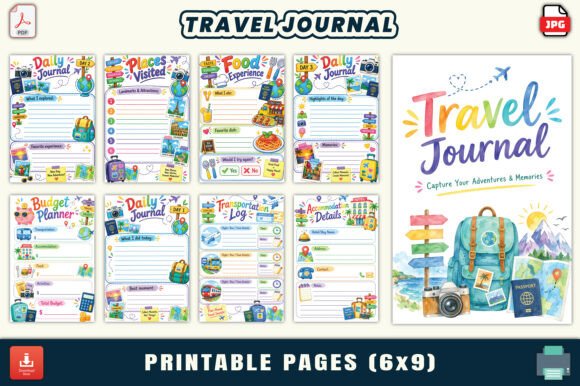
Travel Journal – The One Notebook That Keeps Your Adventures Alive
There is a moment that happens on nearly every trip. You are sitting in a café, on a train, or maybe on a hotel balcony, and you realize that the details are already starting to blur. What was the name of that restaurant? How much did that tour cost? What was the woman at the market actually trying to tell you? That is where a Travel Journal steps in, not as a chore, but as a quiet companion that holds the pieces together.
For anyone between their twenties and fifties, travel tends to look different at each stage. Some are squeezing adventure into a week of annual leave. Others are working remotely from a new city every month. Some are wrangling kids through airport security. And plenty are simply trying to hold onto the memories that matter most. A journal designed specifically for travel helps bridge the gap between the chaos of movement and the clarity of reflection.
When Planning Feels Overwhelming
Planning a trip is exciting, but it can also feel like spinning plates. Flights, accommodation, transfers, meals, activities, budgets. It is easy to lose track of the small details that actually make a trip smooth. People often start with good intentions, scribbling notes on phone apps, sticky notes, or random email drafts. Then they arrive somewhere and cannot remember which hotel confirmation had the early check-in note.
A Travel Journal with dedicated pages for trip overviews, packing checklists, and itineraries turns that scattered energy into something manageable. Instead of hunting through five different apps, you open one journal and see the whole picture. The budget planner and expense tracker pages are especially useful for anyone who wants to keep spending in check without obsessing over spreadsheets while on holiday. You write it down once, and it stays there.
The Solo Traveler's Quiet Ritual
Solo travel has a particular kind of magic, but it also comes with moments of quiet that can feel empty if you are not used to them. A journal becomes a kind of conversation with yourself. Writing down where you went, what you ate, and who you met turns a day of wandering into a story you actually remember.
The daily travel journal pages in this planner give solo travelers a place to land at the end of the day. Not everything needs to be shared online. Some experiences are better kept between the pages. The mood tracker and gratitude page add a layer of self-awareness that many solo travelers find grounding. It is not just about logging sights, it is about checking in with how you actually feel.
For Families Juggling Multiple Schedules
Traveling with family, especially with children, is a different beast entirely. You are not just managing your own preferences, you are managing everyone else's too. Where to eat, when to rest, what activities actually suit different ages. Without some kind of system, the trip can feel like a blur of logistics rather than a shared experience.
A Travel Journal helps families delegate memory keeping without it becoming one person's job. Kids can contribute to the places visited pages or the food experience tracker. The accommodation and transport logs keep everyone on the same page, literally. And when the trip is over, the photo memory pages become a family artifact that everyone can look back on together. It shifts the focus from surviving the trip to actually enjoying it.
Beyond the Trip – Reflection and Gratitude
A lot of travel journals focus only on the planning and the daily log. What sets this one apart is the space it leaves for after the trip. The trip rating and reflection pages are not an afterthought. They are where the real meaning of a journey often surfaces. You look back at what worked, what did not, and what surprised you.
The gratitude page is a small but powerful addition. It asks you to sit with what you appreciated, not just what you saw. That can be a sunset, a stranger's kindness, or simply a good night's sleep after a long travel day. For people in their thirties and forties especially, travel often becomes more about depth than breadth. These pages honor that shift.
Who Else Reaches for a Travel Journal?
It is easy to assume a travel journal is only for leisure travelers. But people use it in surprisingly varied ways.
- Digital nomads use the budget planner and expense tracker to separate work travel from personal exploration. The daily journal pages help them remember where they were when they closed that big project.
- Photographers pair the photo memory pages with their actual prints or digital albums, using the written entries as captions that go deeper than Instagram captions ever could.
- Volunteer travelers lean heavily on the people and culture notes section. When you are working closely with a community abroad, those observations become meaningful records of real connection.
- Business travelers adapt the itinerary and accommodation logs for work trips, adding notes about local restaurants or downtime activities that turn a sterile hotel stay into something more human.
- Gift givers buy it for friends who are about to embark on a gap year, a honeymoon, or a retirement trip. It becomes a present that keeps giving long after the suitcase is unpacked.
What to Think About Before You Start Using One
A journal like this works best when you treat it as a tool, not a test. Some people feel pressure to write something profound every day. That is not the point. Some pages will be full of messy notes, half-finished sentences, and coffee stains. That is the point.
The 6×9 inch size is comfortable for slipping into a carry-on or daypack without adding noticeable weight. The white background with colorful elements keeps it readable and pleasant to look at without being distracting. If you prefer writing with a specific pen or pencil, test it on the paper first. Some gel inks or heavy markers may bleed through thin pages, though with standard ballpoint or fine liner pens, the journal holds up well.
Because it is an instant download in both JPG and PDF formats, you have flexibility. Print it at home, take it to a local print shop, or bind it yourself. Some users print only the pages they need for a specific trip, which keeps the journal lean and customized. Others print the full set and keep it as a consistent record across multiple journeys.
One thing to keep in mind is that this is a printable product, not a pre-bound notebook. That means you control how it is assembled. If you prefer spiral binding, a ring binder, or even a simple stapled booklet, that choice is yours. For people who like to tear out completed pages or add extra inserts, this format is actually more flexible than a traditional bound journal.
Where It Shines and Where It Does Not
Every product has its sweet spot. This Travel Journal shines brightest for travelers who enjoy structure without rigidity. If you like having prompts to guide your thinking but do not want to feel boxed in by them, the balance here works well. The pages give you enough direction to avoid staring at a blank sheet, but they leave room for free writing and personal notes.
It is less ideal for people who prefer purely minimalist or completely unstructured notebooks. If you only ever write in a plain Moleskine and hate any kind of template, then a guided journal may feel like too much. Similarly, if you are looking for a heavy-duty hardcover book that survives being thrown into a backpack for months, you will want to pair the printed pages with a sturdy cover or binder of your choice.
The food experience tracker and shopping log pages are pleasant surprises. Travelers often overlook how much of a trip is shaped by what they eat and what they bring home. Having a dedicated place to note that incredible street food stall or the handmade gift you found at a local market adds texture to the memory. These pages tend to be the ones people flip back to most often after the trip ends.
The photo memory pages are another highlight, but they work best if you actually print your photos. In an age of cloud storage and phone galleries, taking the time to print and paste a picture into a journal feels deliberate. It slows down the act of remembering. People who do this often say it changes how they hold onto a trip compared to scrolling through a digital album.
Small Habits That Make a Difference
Some users keep the journal open on their nightstand during a trip so they can jot down notes before sleep. Others write during breakfast while waiting for coffee. A few fill out the gratitude page on the plane home, before the trip fully settles into memory. There is no right way. The journal adapts to whatever rhythm you bring to it.
For group travelers, passing the journal around for each person to contribute a line or a drawing turns it into a shared artifact. For couples, using one journal together can be a surprisingly bonding experience, as long as both people feel comfortable writing in it. The key is to treat it as a living document, not a polished final product.
The instant download nature of the product means you can start using it immediately, even if your trip is months away. Some people enjoy filling out the traveler profile page and bucket list before they have even booked anything. That act of writing down destinations and dreams has a way of making them feel more real. It turns vague wishes into something you can actually work toward.
And that is really the quiet power of a Travel Journal. It does not just document where you have been. It helps you notice where you are going, what you are feeling, and what you want to carry forward. In a world where most travel memories live on phones and get lost in the shuffle of daily life, putting them on paper makes them last.