36 Puzzle Types 179 Logic Games: A Complete Asset Collection for Creators and Educators
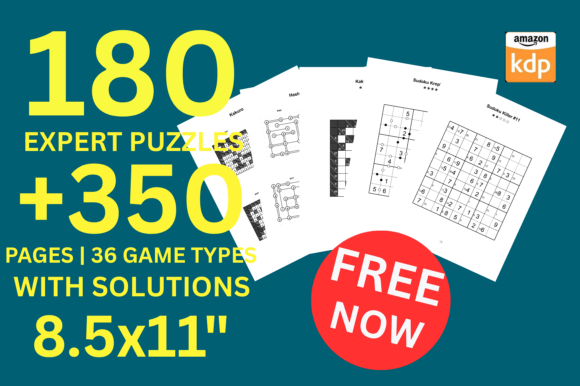
If you have ever tried to assemble a puzzle book from scratch, you know how quickly the process can become overwhelming. Sourcing grids, formatting layouts, ensuring clean resolution, and maintaining consistency across dozens of puzzles takes time that most creators simply do not have. The 36 Puzzle Types 179 Logic Games collection was built to solve that exact problem. It bundles 179 unique, professionally generated puzzles into a single download, all saved as high-resolution PNG files with no watermarks, no branding, and no extra fluff. Whether you are publishing on KDP, designing classroom materials, or prototyping a new app, this pack gives you a ready-to-use library of logic games that spans 36 distinct categories.
What makes this collection different from the usual puzzle bundles is its range. It does not just give you a hundred Sudoku puzzles and call it a day. Instead, it pulls from Sudoku variations, Japanese logic puzzles, strategy classics, word games, mazes, and even geometry puzzles. Each puzzle is accompanied by its solution as a separate PNG, so you get 370 total files. The difficulty ranges from Easy to what the pack calls Evil levels, which means you can serve beginners and puzzle veterans alike without needing to generate anything extra.
What You Actually Get Inside the Pack
The file structure is straightforward. There are no nested zip folders with cryptic names. Each puzzle type has its own folder, and within those folders, you will find the puzzle PNGs and corresponding solution PNGs labeled clearly. The images themselves are crisp, high-resolution files with no tint or background noise. They drop cleanly into any document editor, print template, or digital canvas. Because there are no titles or watermarks baked into the images, you retain full control over how you present them.
The 36 categories break down into several broad groups, each of which deserves a closer look.
Sudoku Variations: 13 Distinct Formats
Most puzzle packs stop at Classic Sudoku and maybe a handful of variants. This collection goes deeper with thirteen Sudoku types:
- Classic Sudoku – Standard 9x9 grid with the usual rules.
- Even-Odd Sudoku – Cells are shaded to indicate whether they must contain even or odd digits.
- Consecutive Sudoku – Adjacent cells with consecutive numbers are marked.
- Killer Sudoku – Cages with sum clues replace some of the given digits.
- Sudoku X – Both main diagonals must also contain digits 1 through 9.
- Hyper Sudoku – Additional internal 3x3 regions impose extra constraints.
- Center Dot Sudoku – The center cell of each 3x3 block holds special significance.
- Greater Than Sudoku – Inequality signs between cells guide the solution.
- Arrow Sudoku – Arrows indicate that the sum of digits along the arrow equals the digit in the circled cell.
- Thermo Sudoku – Digits increase along a thermometer shape.
- XV Sudoku – Adjacent cells that sum to 5 are marked V, and those summing to 10 are marked X.
- Kropki Sudoku – Black and white dots indicate consecutive or doubled relationships between adjacent cells.
- Sandwich Sudoku – Clues outside the grid indicate the sum of digits between 1 and 9 in that row or column.
Each of these has its own folder with multiple puzzles at different difficulty levels. That variety alone makes this pack valuable for anyone creating a puzzle book with a dedicated Sudoku section. Instead of hunting down individual generators for each variant, you have them all in one place.
Mazes: Three Shapes, Endless Pathways
Mazes are often an afterthought in puzzle collections, but this pack treats them seriously. You get Rectangular, Circular, and Hexagonal mazes. Each type has its own visual feel and solving logic. Rectangular mazes are familiar and straightforward. Circular mazes add a spatial challenge that appeals to solvers looking for something different. Hexagonal mazes create a honeycomb grid that changes how paths connect. All three are rendered cleanly, with clear start and end points, making them suitable for both print and digital use.
Japanese Logic Numbers: Seven Classic Styles
This section of the pack is where the logic puzzle enthusiasts will spend the most time. The seven included types are:
- Calcudoku (Mathdoku) – A grid arithmetic puzzle where cages have target numbers and operations.
- Shikaku – Divide the grid into rectangles based on given number clues.
- Hitori – Blacken cells so that no number repeats in any row or column.
- Hashi (Bridges) – Connect islands with bridges following specific count constraints.
- Nurikabe – Paint cells to create a continuous wall while isolating numbered islands.
- Kakuro – Cross sums with a crossword-like layout.
- Minesweeper – Deduce mine locations from adjacent number clues.
These puzzles are often underrepresented in mass-market puzzle books because they require more complex formatting. Having them pre-generated as high-quality PNGs removes that barrier. An educator building a logic curriculum, for example, could pull a Hashi puzzle and its solution in seconds without having to draw the grid by hand.
Strategy Classics: Six Games with a Tactical Edge
Not every puzzle in this collection is a solo logic grid. The pack also includes six strategy game formats that are typically played between two players, but are provided as puzzle layouts here:
- Tic Tac Toe – Multiple board configurations for analysis or play.
- Battleship – Grid-based fleet placement puzzles.
- Dots and Boxes – Dot grids ready for connection gameplay.
- Gomoku – Five-in-a-row on a gridded board.
- Hex Game – Hexagonal board setups.
- Four in a Row – Vertical drop grid configurations.
These are particularly useful for teachers who want to introduce strategic thinking in a classroom setting. Having a set of pre-formatted boards saves preparation time and ensures every student starts with a consistent layout.
Word and Language Challenges: Six Engaging Formats
The language-based puzzles in this pack cover the essentials:
- Word Search – Letter grids with hidden word lists.
- Word Scramble – Anagrams to solve.
- Cryptogram – Substitution cipher puzzles.
- Crossword – Standard crossword grids.
- Wordoku – Sudoku-like grid using letters instead of numbers.
- Hangman – Word guessing puzzle layouts.
For KDP publishers, word search and crossword puzzles consistently rank among the most popular categories in the puzzle book market. Having them included in the same pack as Sudoku variations and logic puzzles means you can build a diversified book without licensing assets from multiple sources.
Drawing and Geometry: Connect the Dots
The collection also includes one geometry-based puzzle type: Connect the Dots. While it is a single category, the puzzles are generated with enough variation to keep the format interesting. This type works especially well for younger audiences or for inclusion in activity books aimed at early learners.
Who Benefits from This Pack
The 36 Puzzle Types 179 Logic Games collection is not aimed at a single type of user. Its value cuts across several groups.
KDP publishers will appreciate the volume and variety. With 179 unique puzzles, you can create a multi-section puzzle book without duplicating entries. The lack of titles or branding on the images means you can arrange them in any order, add your own instructions, and design a consistent cover theme. The separate solution files simplify the back-of-book answer key layout.
Graphic designers who work on activity books, educational materials, or packaging will find the high-resolution PNGs easy to integrate into their workflows. Because the files have transparent or clean backgrounds, they can be placed into layouts without additional editing.
Educators across grade levels can use these puzzles for enrichment, early finisher activities, or logic center stations. Having multiple difficulty levels means the same puzzle type can be used across different age groups. A fourth grader might solve a Beginner Hitori while an eighth grader tackles an Evil Kakuro.
App developers prototyping puzzle games can use the PNGs as placeholder assets during development. While the final app would likely use dynamically generated puzzles, having a static set of well-designed examples speeds up early testing and screen design.
Strengths and Practical Considerations
One of the strongest aspects of this collection is its breadth. Very few puzzle asset packs include thirteen Sudoku types, seven Japanese logic puzzles, and six strategy classics in a single download. The files are organized clearly, and the resolution is good enough for both print and screen use.
The difficulty labeling is another plus. Each puzzle is marked with a level, so you can quickly select appropriate content for your audience. The inclusion of Evil-level puzzles means advanced solvers are not left out.
There are a few considerations to keep in mind. Because the puzzles are provided as PNGs rather than editable formats, you cannot modify the grid values or layout. If you need to tweak a puzzle or generate additional instances, you will need to rely on the included set. For most publishing and design use cases, 179 puzzles provide plenty of material, but if you plan to produce a large series of books, you may eventually want a generator in addition to this asset pack.
Also, the puzzles are untitled and unbranded by design, which is a strength for integration. But this means you must add your own instructions, titles, and page numbers. That is standard for asset packs, but worth noting if you expect fully finished pages.
Real-World Applications
Imagine you are putting together a 100-page puzzle book for Amazon KDP. You want a mix of Sudoku, word searches, and logic puzzles to appeal to a broad audience. With this pack, you can select ten puzzles from the Sudoku variations section, five word searches, five cryptograms, five Kakuros, and five Hashi puzzles. Add mazes and Connect the Dots for variety. You now have a diversified book with minimal overlap, and every puzzle has a matching solution file.
Or consider a classroom teacher preparing a Friday enrichment packet. You can pull one Easy Sudoku, one Calcudoku, one rectangular maze, and one Wordoku. Print them directly from the PNGs and hand them out. No time wasted formatting grids.
A graphic designer laying out a children's activity magazine can pull thematic puzzles, resize them as needed within the high-resolution limits, and place them alongside illustrations. The lack of watermarks means the puzzles integrate seamlessly into the final design.
Evaluating Suitability for Your Project
Before purchasing or downloading any puzzle asset collection, ask yourself three questions: Does the variety match your audience? Is the resolution adequate for your output format? Do you have the time to integrate untitled assets into your layout?
If your project needs deep variety with multiple puzzle categories, this collection is a strong fit. The 36 types cover most of the popular puzzle formats in the market today. If you specifically need high volume in a single type, you might want a dedicated set for that category. But for a sampler that gives you everything from Sudoku to Bridges to Gomoku, the 36 Puzzle Types 179 Logic Games pack delivers exactly what it promises: a massive variety of logic game assets ready to use.
The free availability of this pack further lowers the barrier. You can test it on a small project, see how the files work with your design pipeline, and then decide if you need additional volumes or specialized generators. For many creators, this single collection will be enough to launch several puzzle books or fill an entire semester of logic activities.
In a market where puzzle assets are often scattered across dozens of sources, having 179 professionally generated puzzles in one clean download saves time, reduces friction, and lets you focus on the actual creation work.