Healthy Baking Recipe Collection: A Practical Resource Thoughtful Bakers Should Consider
If you have spent any time exploring healthier alternatives in the kitchen, you already know that baking with whole grains, natural sweeteners, and nutrient-dense ingredients is not quite as straightforward as reaching for all-purpose flour and refined sugar. The science changes. The ratios shift. And without reliable guidance, even experienced home bakers can end up with dense loaves, dry muffins, or cookies that spread into flat discs. That is precisely where the Healthy Baking Recipe Collection enters the conversation. It is not another pretty recipe book with stylized photographs and vague promises. It is a structured, workbook-style resource that combines education, planning tools, and tested recipes into a single print-ready package. And for anyone who creates content, teaches wellness, or simply wants to bake smarter, it deserves a closer look.
What the Healthy Baking Recipe Collection Actually Contains
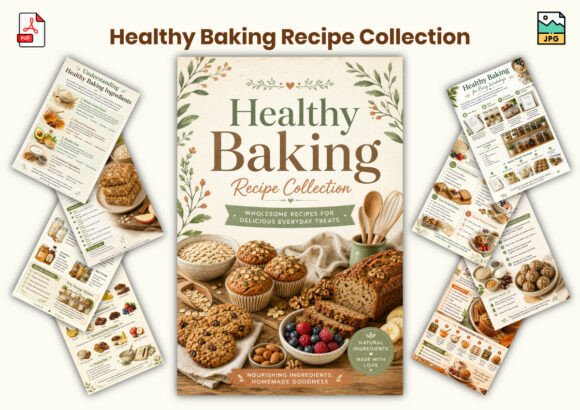
The collection is built around 31 unique interior pages designed at 6 × 9 inches, a size that works well for both digital tablets and printed booklets. The pages are provided as high-quality JPG files and a print-ready PDF, which means you can use the material flexibly across multiple formats. The design follows a fresh organic aesthetic, which translates to clean layouts, muted natural tones, and a visual style that avoids looking overly commercial or artificial. It feels grounded, which is appropriate for a resource focused on wholesome ingredients and mindful baking habits.
Inside, you will find material organized into several distinct categories. There are educational sections covering healthy baking fundamentals, whole grain flour education, natural sweetener guides, and nuts and seeds baking information. Then come the actual recipes: banana oat muffins, blueberry breakfast loaf, healthy chocolate oat cookies, pumpkin spice muffins, and apple cinnamon snack bars. Each recipe sits inside a broader framework that includes pantry organization guidance, baking infographics, goal-setting pages, habit trackers, recipe notes pages, and reflection and progress review sheets. In other words, the collection functions as both a recipe book and a structured planning system for anyone serious about integrating healthier baking into their routine or content offering.
Strengths That Matter for Real-World Use
One of the first things worth noting is the educational depth. Many recipe collections assume you already know why certain substitutions work or how different flours behave. This resource does not make that assumption. The whole grain flour education section, for example, explains the functional differences between whole wheat pastry flour, spelt, oat flour, and almond flour. It discusses absorption rates, gluten structure, and how to adjust liquid ratios. That kind of information transforms a recipe from a one-time attempt into a repeatable skill. If you are a blogger or content creator, that educational layer also gives you material you can repurpose into blog posts, social media content, or email sequences without needing to reinvent the wheel.
The natural sweetener guide follows a similar approach. Instead of simply telling you to swap sugar for honey or maple syrup, it covers how different sweeteners affect browning, moisture content, and texture. It also addresses conversion ratios, which is a detail many casual resources overlook. For someone running a small food business or publishing recipes for an audience, having this information integrated into the same document as the recipes themselves saves significant research time and ensures consistency across your output.
The inclusion of planning and tracking pages is another practical strength. Goal-setting templates, habit trackers, and reflection sheets may sound like extras, but they serve a real function when you are developing content series, meal plans, or course material. If you are an educator or wellness coach, these pages give you a framework you can hand directly to clients or students. If you are a freelancer or creator, they provide ready-made assets you can bundle into larger offers without starting from scratch.
Quality of Design and Presentation
The clean, professional layout is worth a specific mention because it directly affects usability. The pages are not overcrowded with decorative elements that obscure the information. Headings are clear, text is legible, and the spacing supports note-taking. The JPG files are high-resolution and suitable for digital distribution or light print use, while the print-ready PDF ensures that a physical copy will come out crisp and correctly sized. The 6 × 9 inch format is a common trim size for small cookbooks and workbooks, so any creator planning to release a printed version through platforms like KDP will find that this collection fits that ecosystem without requiring extensive reformatting.
The fresh organic aesthetic is consistent throughout the 31 pages. It is not flashy, but it does not need to be. The visual tone supports the content rather than competing with it, which is a sign that the design was developed with a clear understanding of the target audience. People looking for healthy baking resources are often drawn to natural, understated visuals, and this collection delivers that without resorting to clichés.
Realistic Performance in Practice
From a practical standpoint, the recipes themselves are where the collection will either succeed or fall short for individual users. The selection covers five recipes, which is a modest but manageable number. Each recipe focuses on whole food ingredients and avoids processed additives. The banana oat muffins and blueberry breakfast loaf are the sorts of recipes that appeal to a broad audience, including parents, busy professionals, and anyone looking for make-ahead breakfast options. The healthy chocolate oat cookies and pumpkin spice muffins tap into seasonal and comfort-driven baking, which tends to perform well in content calendars. The apple cinnamon snack bars round out the set with something portable and snackable.
That said, five recipes may feel limited if you are looking for a comprehensive baking resource. This collection is not designed to be an encyclopedia of healthy baking. It is a focused, curated set of recipes combined with educational and planning material. If you need dozens of cookie variations or an exhaustive exploration of gluten-free baking, you will need additional resources. But if your goal is to create a complete content package or course around a handful of well-tested, versatile recipes, the scope here makes sense. The supporting pages allow you to expand the utility far beyond the recipes themselves.
Who Benefits Most from This Collection
Given the structure and content, several types of users will find genuine value here. Content creators and bloggers working in the food, wellness, or lifestyle space can use the educational sections as a foundation for articles, videos, or social media series. The infographics and guides are particularly useful for visual platforms like Pinterest or Instagram. Educators and coaches who teach nutrition, cooking, or healthy living can incorporate the planning pages into student materials or client workbooks. The goal-setting and reflection pages add a layer of accountability that pure recipe collections lack.
Small business owners launching a healthy food product line or a baking-focused service can use this collection as a lead magnet, a bonus for a paid course, or a printed supplement for in-person workshops. The licensing terms matter, so confirm what is allowed for commercial redistribution, but for creators who develop their own original content around these pages, the collection provides a polished starting point. Freelancers and publishers looking for KDP-friendly interior designs will appreciate that the format is pre-optimized for that platform, reducing the production time needed to bring a printed book to market.
Even serious home bakers who are not creating content for an audience will find the educational material useful if they want to understand the why behind healthy baking. The collection encourages a more thoughtful approach rather than just providing a list of instructions to follow blindly.
Practical Limitations to Consider
No resource is perfect for every situation, and this collection has boundaries worth acknowledging. The number of recipes is limited. If you want a library of dozens of healthy baking recipes, you will need to supplement this with additional material or create your own. The design, while clean and professional, is not customizable at the source file level based on what is provided. You receive ready-made JPG and PDF files, not editable templates. If you want to change fonts, colors, or page layouts, you will need to rebuild the pages in your own design software.
Also, the collection is focused specifically on baking. It does not cover other areas of healthy cooking or meal preparation. If your audience or workflow requires a broader nutrition resource, you would need to combine this with other assets. Finally, while the recipes are developed around whole food ingredients, individual results will always vary based on ingredient quality, oven calibration, and personal taste preferences. The collection provides guidance, but it cannot guarantee outcomes in every kitchen.
Recommendations for Getting the Most from It
If you decide to use this collection, treat it as a foundational layer rather than a complete product on its own. Pair it with your own original content, additional recipes, or video demonstrations. The planning and tracking pages work well when integrated into a longer course or coaching program where participants can track their progress over several weeks. For content creators, use the educational sections as research material and create derivative content that expands on the concepts introduced in each guide. That approach respects the work already done while building something unique around it.
Consider printing a test copy to evaluate the physical quality before distributing it widely. The print-ready PDF is designed for professional output, but printer settings and paper quality will affect the final result. If you are using the JPG files for digital distribution, test them on different devices to ensure the text remains legible and the layout holds up across screen sizes.
For KDP publishers, the 6 × 9 inch format and clean interior design give you a strong starting point. You can add a cover, adjust metadata, and have a product live relatively quickly. Just be sure to add enough original content and differentiation so that your listing provides unique value beyond the base collection itself.
Final Observations
The Healthy Baking Recipe Collection succeeds most where many similar resources fall short: it treats healthy baking as a skill to be learned rather than a set of substitutions to be memorized. By combining educational content with practical planning tools and a small but solid set of recipes, it offers more utility than a standalone recipe book and more focus than a general wellness workbook. It will not replace years of baking experience or eliminate the need for experimentation, but it provides a thoughtful, usable framework for anyone who wants to bake healthier and help others do the same. For creators, educators, and business owners who need a professional, ready-to-use resource with genuine instructional value, it is a practical tool worth integrating into your workflow.